Here is the short answer on equipment leasing vs buying. Lease when you need to keep more cash on hand or the equipment goes out of date fast. Buy when you have the cash or credit and will use it for a long time.
The U.S. Small Business Administration (SBA) says buying usually costs less over the life of the equipment, while leasing needs less money up front [1].
Your own answer turns on six things: how long you will use it, how fast it ages, your cash, the total cost, upkeep and taxes. We take them one at a time below.
Equipment leasing vs buying at a glance
| Leasing | Buying | |
|---|---|---|
| Cash up front | Less cash or credit needed [1] | More cash or credit needed [1] |
| Cost over the life of the equipment | Normally higher [1] | Usually lower [1] |
| Who owns it | Usually the leasing company; you pay to use it [2] | You do [2] |
| Upkeep | Sometimes included, depending on the lease [1] | You may have to pay for all of it [1] |
| Taxes | Payments may be deductible as rent if the IRS treats the deal as a lease [8] | You can generally claim depreciation (deduct the cost over time) [1][3] |
| Trying it first | Short leases let you test it [1] | Less chance to test it [1] |
| At the end | Return it, or buy it if the lease has a buyout option [1] | It is yours to keep or sell |
These points come from two SBA pages for small businesses [1][2]. Every lease and loan is set up differently, so always read the terms of the offer in front of you [1].
How leasing equipment works
When you lease, the leasing company owns the equipment. You pay to use it for the length of the lease [2]. It works a lot like renting, with a written contract.
Leasing can make sense when you need a lot of equipment quickly, or when the equipment is very costly [1]. The SBA also notes that leasing can sometimes cost less than buying with a high-interest loan [1].
The two main kinds of leases
The SBA describes two general kinds of leases: operating and capital [1]. They are handled differently in your books, so the type you choose can have a big effect on your taxes [1].
- Operating lease. This works like a rental. You use the equipment for a time and plan to replace it at the end [2]. This type is often used for fast-changing items like computers and copiers [2].
- Capital lease. This is often used when you plan to own the equipment at the end [2]. One example is leasing equipment for almost its whole working life [7]. The SBA blog suggests it for machinery you plan to keep [2]. Whether you can buy or own the equipment at the end depends on what your lease says.
Newer U.S. accounting rules sort leases into finance leases and operating leases. The older rules used the name capital lease [7]. Under these rules, a lease that lasts more than 12 months shows up on your balance sheet, whichever type it is [7]. A balance sheet is the list of what your business owns and owes. Your accountant can tell you how a lease will show up in your books.
You may also see leases named by how they end. With a fair market value (FMV) lease, the end price is what the equipment is worth at that time. It has lower monthly payments and more choices at the end. A $1 buyout lease lets you buy the equipment for $1 when the lease ends, but the monthly payments are higher [2].
Lease terms that change the deal
Leases are not all alike. Look closely at these parts of any offer [1]:
- Buyout option. Some leases let you buy the equipment when the lease ends.
- Length. Shorter leases usually have higher monthly payments.
- Early exit. If you end a lease early, you may face steep early-termination penalties.
If any terms are unclear, the SBA suggests asking an attorney to review the lease with you before you sign [1].
How buying equipment works
You can buy equipment with cash or with a loan.
Paying cash means you own it in full right away. The catch is that you will have less cash left for running costs like payroll and supplies [1]. Before you pay cash, make sure your business can truly afford it [1].
Borrowing spreads the cost over time, much like a lease does. But you will pay more in fees and interest than if you paid cash [1]. A business term loan is often recommended for buying equipment or a vehicle [4]. You borrow a set amount and repay it in regular payments over three or more years [4]. The equipment itself is often the security for the loan [4]. Security, also called collateral, is property the lender can take if the loan is not repaid.
SBA-backed loans (loans from a lender that the government partly guarantees) can help too. A 7(a) loan can pay for buying and installing machinery and equipment [5]. As of 2026, a 504 loan can pay for long-term machinery and equipment that should keep working for at least 10 more years [6]. Our guide to business loan requirements explains what lenders check before they say yes.
6 questions to help you decide
Work through these in order. If most of your answers point the same way, you have your choice.
1. How long will you use the equipment?
Do you have the cash or credit, and are you sure you will use it for a long time? Then buying can be a good option [1]. You pay once, and the equipment keeps working for you after the loan is paid off.
If you plan to replace the equipment when the lease ends, an operating lease is built for that [2]. A short lease is also a way to test equipment before you commit [1].
2. How fast will it go out of date?
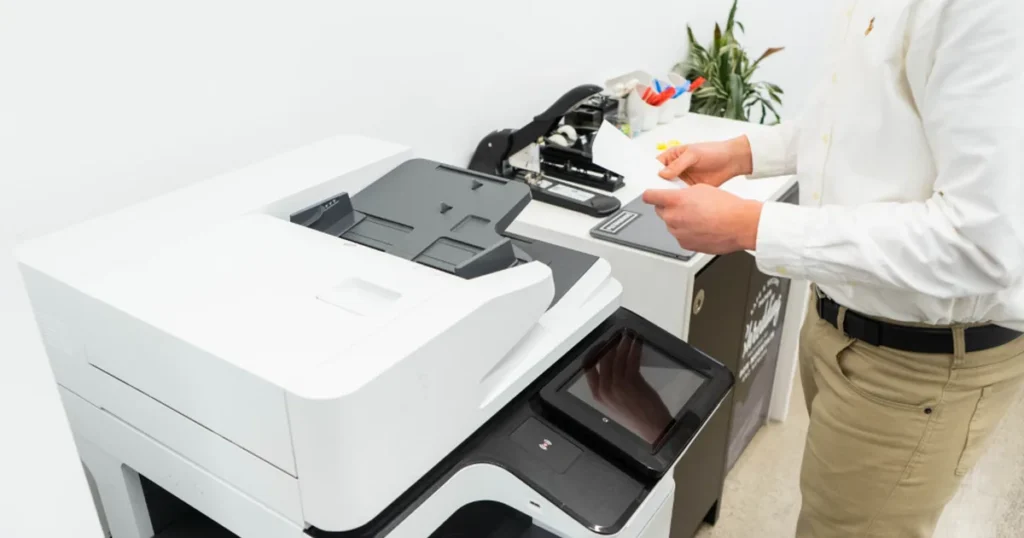
Some equipment ages slowly. A metal press or a delivery truck may do the same job for many years. Other equipment, like computers and copiers, gets replaced often. That is where operating leases are most often used [2].
If you expect to want a newer model in a few years, leasing can keep you from owning something that is out of date.
3. How much cash can you spare right now?
Leasing needs less cash or credit up front [1]. Buying needs more [1]. If paying cash would leave you short for payroll or supplies, a lease or a loan spreads the cost out instead [1].
This is not only about the price tag. Think about what else that cash has to cover in the next few months. List your bills for the next three months, then see what is left after the purchase.
4. What will it cost in total?
Do not stop at the monthly payment. The SBA says the lifetime cost of a lease is normally higher than buying [1]. A loan also adds fees and interest on top of the price [1].
A useful way to compare is the total cost of ownership. That means every cost of the equipment added together: getting it, paying for it, running it, and replacing or selling it at the end.
Here is a simple made-up example to show the math. These numbers are not real offers.
| Lease | Loan | |
|---|---|---|
| Equipment price | $40,000 | $40,000 |
| Paid up front | $0 | $4,000 |
| Monthly payment | $1,000 for 48 months | $900 for 48 months |
| Total paid over 4 years | $48,000 | $47,200 |
| End of term | Give it back, or pay to buy it | You own it |
In this example, the lease needs no cash up front. The loan needs $4,000 at the start but costs less in total, and you keep the equipment. But the real answer depends on the actual rate, fees and end-of-lease price in each offer. Line up every offer this way before you choose.
This example counts only the payments. It leaves out upkeep, insurance, taxes, fees and what the equipment could sell for later. If you plan to keep leased equipment, add the cost to buy it when the lease ends. If you buy, think about what the equipment will still be worth. Any of these can change which option costs less.
5. Who will handle repairs and upkeep?
With some leases, maintenance is included at no extra cost [1]. When you buy, you may be fully responsible for repairs and for replacing the equipment [1].
Ask each provider what upkeep is included in writing. Then add your own repair costs to the buying side of your comparison. Some equipment also needs parts, service visits or insurance, so ask what the lease covers and what it leaves to you.
6. How will it affect your taxes?
The tax side starts with one question: is your deal really a lease? The IRS looks at what you and the leasing company meant, based on your agreement and the facts when you signed it [8].
- If it counts as a lease, you may deduct the payments as rent [8].
- If it is really a purchase (the IRS calls this a conditional sales contract), you are treated as the buyer. You generally get back the cost through depreciation instead [8].
Some signs point to a purchase [8]. One is getting title after a set number of payments. Another is an option to buy for a tiny price compared with the equipment’s value. No single sign always decides it [8]. Still, $1 is a tiny price, so a $1 buyout lease may be treated as a purchase for taxes. The SBA blog also notes that this kind of lease comes with depreciation [2].
When you buy, you can generally claim depreciation [1]. Depreciation lets you get back the cost of business property through tax deductions over the time you use it [3]. The IRS has detailed rules on how much you can deduct and when [3].
With a true lease, you generally cannot depreciate the equipment, because you do not hold the “incidents of ownership” [3]. These include the legal title, the legal duty to pay for the equipment, and paying for its upkeep and running costs [3].
Ask a tax professional to review the agreement before you claim any deductions.
Tax rules have many details and exceptions, so talk with a tax professional about your own case before you decide.
You can lease some items and buy others
You do not have to make one choice for everything. Run the six questions for each item on its own. A copier you will swap out in three years may fit a lease. A machine your crew will use for ten years may be worth buying.
That way your cash is not tied up in gear you will swap out soon. And you own the machines you will use for years. Look at the total cost of each item, not just the monthly payment.
Before you decide, get at least two or three offers. Add up the total cost over the time you expect to use the equipment. Think about how each choice affects your cash flow. The lowest monthly payment is not always the cheapest choice.
Before you sign: a short checklist
- Compare offers. Do not assume your bank or the maker’s finance company will give you the lowest cost. Compare rates, lease terms, fees and options [2].
- Check your credit first. Review your credit reports and gather your financial papers before you apply [2].
- Know the lease type. Ask if it is an operating or capital lease [1]. Also ask if it is a fair market value or $1 buyout lease [2].
- Read the end-of-lease terms. What happens if you want to buy, return or renew it?
- Ask about early exit. Find out the penalty for ending the lease early [1].
- Get upkeep in writing. Find out what maintenance is included [1].
- Get help with unclear terms. Have an attorney review anything you do not understand [1].
Limits and risks to weigh
- Leasing can cost more over time. The total you pay is normally higher than buying [1].
- You may be locked in. Ending a lease early can bring steep penalties [1].
- Replacing leased equipment can be costly. When the lease ends, getting new equipment could be expensive [1].
- Buying ties up cash. Paying cash leaves less for running the business [1].
- Loans add cost and risk. You pay fees and interest [1], and the equipment is often the security for the loan [4]. If you cannot repay, you could lose it.
Equipment leasing vs buying has tax and legal sides as well as money ones. Before you sign, talk with an accountant or attorney about your own situation.
How we can help
15X Financial Solutions helps business owners access business funding resources, including equipment financing options. To learn more, see our equipment financing page or contact our team. If a loan makes more sense, you can also read about our SBA loan options.
Frequently asked questions
Is leasing equipment cheaper than buying?
Usually not over the long run. The SBA says the lifetime cost of leasing is normally higher than buying [1]. But leasing needs less cash up front, and it can sometimes cost less than buying with a high-interest loan [1].
Can I deduct lease payments?
Usually. Lease payments for business equipment are typically tax deductible [1]. But first the IRS must see your deal as a real lease. Then you may deduct the payments as rent [8]. If the deal is really a purchase, you generally use depreciation instead [8]. Ask a tax professional to check your agreement.
Can I buy the equipment when the lease ends?
Sometimes. Some leases have a buyout option [1]. With a $1 buyout lease, you can buy the equipment for $1 at the end, but the monthly payments are higher [2].
What is the difference between an equipment lease and a loan?
With a loan, you buy the equipment and own it, even while you are still paying [2]. With a lease, the leasing company owns it and you pay to use it [2].
This article is for general information only. It is not financial, tax or legal advice. Talk with a qualified professional about your situation.
Sources
- U.S. Small Business Administration, “Buy assets and equipment” (Business Guide): leasing and buying benefits and drawbacks, lease types, lease terms, cash vs loans
- U.S. Small Business Administration blog, “Business Equipment Financing & Leasing: 7 Key Tips to Know” (Marco Carbajo, SBA blog contributor, 2017): ownership, operating vs capital leases, FMV vs $1 buyout leases, tips
- Internal Revenue Service, Publication 946, “How To Depreciate Property”: leased property and depreciation
- FDIC, “Business Cents: Making Sense of Small Business Expenses” (Consumer News, November 2019): term loans for equipment
- U.S. Small Business Administration, “7(a) loans”: equipment as a 7(a) use
- U.S. Small Business Administration, “504 loans”: long-term machinery and equipment
- Financial Accounting Standards Board, “FASB In Focus: Accounting Standards Update No. 2016-02, Leases (Topic 842)”%20(Rev%206-3-20).pdf): finance and operating leases on the balance sheet
- Internal Revenue Service, “Income & Expenses 7” (FAQ: lease payments or depreciation?): lease vs conditional sales contract

Founder & CEO, 15X Business Solutions
Serial Entrepreneur | Growth Strategist